
“The key for me is the attention to detail, they get everything without ever missing bits which wasn’t the case with others I’d used in the past.”

Look Design & Build


Construction costs vary significantly by project type, specification, and location. These benchmarks give you a starting framework – your ProQuant estimate gives you the project-specific numbers that actually matter.
2026 COST DATA – All figures are indicative build works costs only at a UK national average location (Q4 2025 BCIS baseline). London and South East add 15–25%. Northern England and Wales are typically 10–15% below the national average.
| Development Type | Build Cost (per m²) | What This Covers | What It Excludes |
|---|---|---|---|
| New Build Residential Standard–Good Spec | £1,800–£3,200 | Substructure, superstructure, external envelope, internal finishes, M&E, preliminaries | Land, VAT, professional fees, planning, landscaping, utility connections |
| New Build Residential Premium / London Spec | £3,200–£4,500+ | High-spec finishes, complex design, enhanced glazing, underfloor heating | Land, VAT, fees, planning costs, site infrastructure |
| Commercial Office / Retail | £1,800–£3,000 | Shell and core plus standard fit-out | Specialist fit-out, equipment, VAT, fees, planning |
| Industrial / Warehouse | £600–£1,200 | Steel portal frame, concrete floor, basic services | Specialist racking, plant, VAT, fees, planning, site works |
| Residential Extension Single or Double Storey | £1,600–£2,800 | Structural works, finishes, M&E connections, glazing | Planning, structural engineer, kitchen/bathroom furniture |
| Conversion / Refurbishment Commercial to Residential | £500–£1,500 | Varies – strip-out, structural works, fit-out | Fees, planning/permitted development, VAT (typically 5%) |
Always commission a professionally prepared estimate before committing to a development budget.
“The key for me is the attention to detail, they get everything without ever missing bits which wasn’t the case with others I’d used in the past.”
“The service from the guys is perfect too, any questions or queries they’re always available to answer and help, really efficiently”
“I found as soon as I started working with them I started winning all my jobs, at least 9/10 and I’ve not lost a penny on the estimates they’ve priced for me.”
A straightforward four-step process – from submitting your plans to receiving a detailed, professional estimate you can actually use.
A ProQuant development cost estimate is not a guess or a rule-of-thumb figure. It is a detailed breakdown of every cost element relevant to your scheme.
Getting your property development costs wrong at the feasibility stage is one of the most common – and most expensive – mistakes developers make. A figure that is 15% too low can turn a profitable scheme into a loss-maker before the foundations are even in.
ProQuant’s estimating service is built around accuracy, speed, and professional rigour. We use current UK market rates, BCIS benchmarks, and NRM measurement methodology to produce estimates you can rely on – whether for your own appraisal, a lender’s requirement, or a contractor’s brief.
Whether you are assessing a site for the first time or pricing a scheme for tender, ProQuant gives you the cost clarity you need to move forward.
From site feasibility through to tender, accurate development cost estimates are the foundation of every viable scheme.
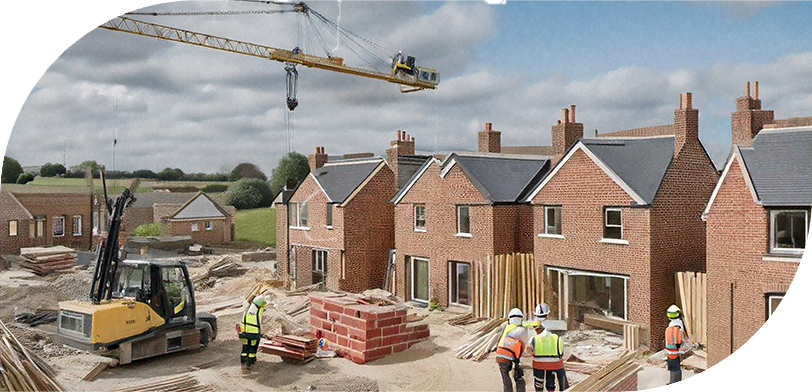

Understand exactly what your self-build or custom build will cost before you commit to the plot or proceed with planning.
Provide your clients with reliable cost guidance and manage the tender process with confidence.

Property development costs in the UK encompass far more than the headline build cost per square metre. For a development to stack up financially – whether you are building a single dwelling or a multi-unit residential scheme – you need an accurate picture of every cost from land acquisition through to practical completion.
The most reliable way to cost a development is from measured drawings, using current market rates and professional estimating methodology. Generic online property development calculators can provide a rough order-of-magnitude figure, but they cannot account for your specific design, your ground conditions, your regional subcontractor market, or the procurement route you intend to use. These factors can move the real cost 20–30% in either direction.
Before construction begins, a developer faces a significant range of startup and pre-development costs that must be factored into the overall appraisal. These typically include:
A land development cost estimate focuses specifically on the costs of preparing a site for construction – the infrastructure work that must happen before any building begins. On a greenfield or brownfield site, this can represent a substantial proportion of the overall development budget.
Land development costs typically include site clearance and demolition, remediation of contaminated land, access road and estate road construction, surface water and foul drainage infrastructure, utility diversions, retaining structures, and any abnormal groundworks required to overcome poor bearing capacity or groundwater. On challenging sites, these costs can run to hundreds of thousands of pounds and must be identified at the appraisal stage to avoid fatally undermining the scheme’s viability.
The cost profile of commercial and residential developments differs significantly. Residential new build typically involves a higher level of internal fit-out and finish, and costs are heavily influenced by the specification level and housing type – detached houses cost more per m² than terraced houses due to greater wall-to-floor ratio; bungalows cost more than two-storey houses due to proportionally larger roof and foundation areas.
Commercial development costs depend heavily on the use class. Office buildings require more sophisticated mechanical and electrical services than warehouse units. Retail units may require significant external works and car parking. Specialist uses – healthcare facilities, food production, laboratories – carry substantial additional cost premiums above standard commercial rates.
An online property development calculator is a useful starting point, but it cannot replace a professionally prepared estimate when real money is on the line. A development appraisal built on calculator outputs that are 10–15% too low may show a healthy profit at inception but deliver a loss when actual tenders come in. By that point, land has been purchased, fees have been committed, and options are limited.
An accurate, professionally prepared property development cost estimate from ProQuant allows you to make informed decisions before you commit capital. It gives lenders confidence in your appraisal, provides a benchmark against which contractor tenders can be assessed, and identifies early on the cost elements most likely to cause problems – giving you the opportunity to value-engineer the design or adjust the scheme before it is too late.
Fixed fee. 5-day turnaround. Detailed, itemised, and easy to understand. Send us your plans and we will get to work.
Build costs for a standard new build residential property in the UK range from approximately £1,800 to £3,200 per square metre at standard to good specification (Q4 2025 BCIS data). A typical three-bedroom house of 110m² would have a build works cost in the range of £198,000 to £352,000 before land, professional fees, VAT (new build residential is zero-rated), and planning costs. London and the South East carry a 15–25% premium above national averages.
Commercial development costs range from £600–£1,200 per m² for industrial uses up to £1,800–£3,000 per m² for office and retail. Your specific costs depend on design, specification, site conditions, and location.
A ProQuant development cost estimate covers all construction works elements: substructure (foundations, drainage), superstructure (walls, floors, roof), external envelope (windows, doors, cladding), mechanical and electrical services, internal finishes, and on-site preliminaries. Depending on your requirements, we can also include external works and landscaping, and flag the additional costs – land, fees, planning, utility connections, warranties, and finance – that form part of the total development budget. We present the estimate in a clear, itemised format that you can use for your own appraisal or provide to a lender or funder.
Our standard turnaround is 5 working days from receipt of your plans and drawings. For projects where time is critical – a deal deadline, a planning meeting, or a lender’s requirement – we offer an express next-day service. Contact us to discuss your timeline and we will accommodate it wherever possible.
We can produce estimates from planning permission drawings, full architectural drawings, building regulation drawings, or early sketch plans. The more detail available in the drawings, the more accurate the estimate will be. If you are at early feasibility stage and have only outline plans, we can still produce a meaningful order-of-magnitude cost – clearly flagging the assumptions made and the elements where costs may vary.
Yes. ProQuant covers the full range of property development types – domestic new build, self-build, residential extensions, conversions, mixed-use developments, commercial new build, office and retail fit-out, and industrial. We work with individual self-builders, residential developers, commercial developers, architects, and agents.
Many of our clients use ProQuant estimates to support development finance applications and to satisfy lender due diligence requirements. A professionally prepared, itemised cost estimate from an established estimating service demonstrates to funders that your cost appraisal is grounded in real market data rather than guesswork. If your lender has specific requirements for the format or content of a cost report, let us know at the time of instruction.
The factors that most commonly cause real costs to diverge from initial estimates are: ground conditions and abnormal substructure requirements; specification decisions (the difference between standard and high-spec finishes can be 30–50% on the same footprint); location (London commands 25–30% above the national average); procurement route (negotiated contract vs competitive tender); design complexity; and programme (compressed programmes almost always cost more). A ProQuant estimate accounts for the information available in your drawings and makes its assumptions explicit.